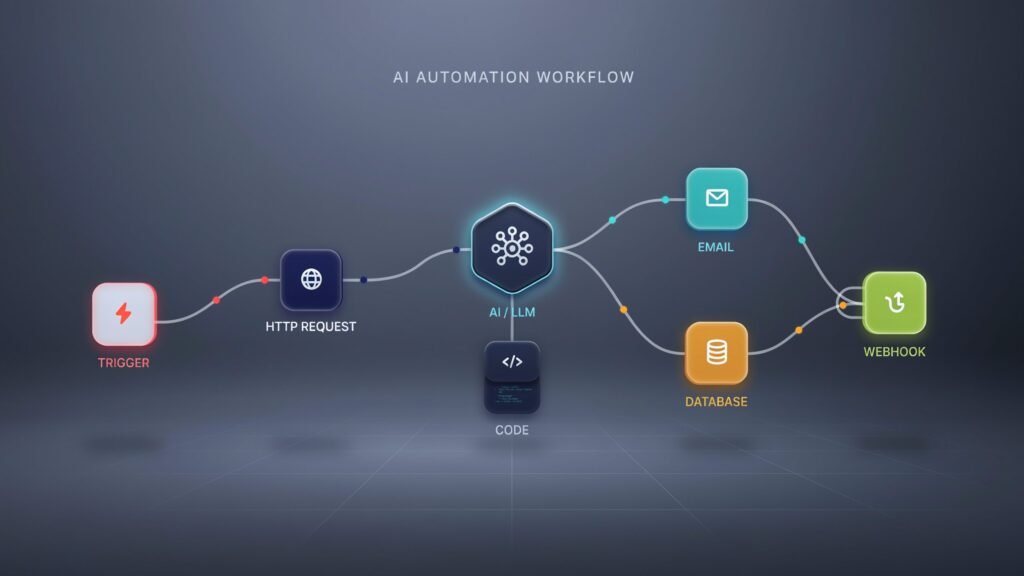
An AI automation agency builds and runs the systems that connect your existing tools — CRM, inbox, spreadsheets, billing — so work moves between them without a person copying data. The good ones scope one process, ship it, and measure it. RAND found more than 80% of AI projects deliver no business value, and scope is usually why.
What does an AI automation agency actually do?
It removes manual steps between systems you already pay for. That is the job, stripped of the vocabulary.
The work falls into four parts, and only one of them is glamorous:
- Process mapping. Sitting with the person who does the task and recording every step, including the ones they do not think of as steps — the check against a spreadsheet, the judgement call about which colleague to forward it to.
- Integration. Wiring the systems together so a form submission reaches HubSpot, the invoice reaches the accounts package, and the status reaches the person waiting on it.
- A judgement layer, where one is genuinely needed. Where a fixed rule cannot decide — reading a free-text email and working out which of nine processes it belongs to — a model call makes the classification.
- Operation. Logging, error handling, alerts, and the changes required when a vendor alters an API.
Most of what is sold as AI automation is the second bullet with a model call bolted on. That is not a criticism. Integration is where most of the recovered hours actually come from, and an agency that tells you your problem is a plumbing problem rather than an AI problem is usually the honest one in the room.
What is the difference between an AI automation agency and an AI consultant?
An agency builds and operates; a consultant advises and leaves. Both are legitimate, and confusing them is how businesses end up with a strategy document and no working software.
An AI implementation consultant is worth paying when you have a real internal team and need direction — which processes to prioritise, what the architecture should look like, whether the vendor you are about to sign with is credible. You get a recommendation, and you execute it.
An AI automation agency is worth paying when you have nobody who will own the build and nobody who will get paged when it breaks. You are buying a running system and the person responsible for keeping it running.
The failure mode is buying the first and expecting the second. If your engagement ends with a roadmap and no automation in production, you bought consulting — which is fine, as long as that is what you meant to buy.
Why do most AI automation projects fail?
Scope kills them, not technology. The numbers here are unusually consistent across independent studies, which is rare enough to be worth taking seriously.
RAND Corporation’s 2024 analysis found more than 80% of AI projects fail to deliver their intended business value — roughly twice the failure rate of IT projects without AI. The breakdown is more useful than the headline: about 34% are abandoned before they ever reach production, and about 28% reach production but never deliver the expected value.
Gartner predicted that at least 30% of generative AI projects would be abandoned after proof of concept by the end of 2025, citing poor data quality, unclear business value and escalating costs. MIT’s Project NANDA research put the share of generative AI pilots delivering no measurable profit-and-loss return at roughly 95%.
Read those failure modes closely and a pattern falls out. The projects do not collapse because the model was not clever enough. They collapse because nobody defined what success looked like in a number, the scope was the whole department instead of one process, and the pilot was never wired into the system where the work actually happens.
That is a scoping and ownership problem. It is also the thing you are hiring an agency to get right, which makes it the thing to interrogate before you sign.
What should an AI automation agency deliver in the first 30 days?
One automation running in production, with logs you can read. Not a strategy deck, and not a discovery phase that rolls into a second discovery phase.
A reasonable first month looks like this:
- Week one: pick one process with a clear right answer — lead routing, invoice coding, ticket triage — and shadow it. You need to be able to grade the output against what your team actually did.
- Week two: build it, and run it in shadow mode. It proposes; nobody acts on the proposal. Every proposal is logged next to the human decision.
- Week three: compare. If it is not right at least 90% of the time on your real data, it will not be right in production either, and the honest move is to narrow the scope rather than ship it.
- Week four: put it live with an approval gate on anything irreversible, and hand over the logs.
The value of that sequence is that it fails cheaply. You find out in week three, for a few thousand dollars, what the 80% find out after a year.

How do you tell a real AI automation agency from a reseller?
Ask where the automation lives and who holds the credentials. The answer sorts the field quickly.
Some specific questions that are hard to bluff:
- “Can I see a running workflow and its execution logs?” Not a screenshot, not a case study PDF. A real system has an ugly error log, and being shown one is a good sign.
- “If we stop working together, what do we keep?” An automation built on n8n, Make or Zapier in an account you own is yours. One that lives inside the agency’s own platform is a subscription you cannot leave.
- “What are the ongoing costs, including model and platform fees?” An agency that quotes only a build fee either has not run one of these for a year or is hoping you will not notice the second invoice.
- “What would you refuse to automate for us?” Anyone who has done this has a list — anything irreversible without a human check, anything touching money without an approval gate. No list means no scars.
- “Which of your people will be on this, and what have they built?” Named humans, not a capability slide.
The last thing to check is whether the credentials they will hold are scoped. A workflow that runs on an admin API key to your CRM is a liability wearing a productivity costume. A competent build gets its own credential, scoped to the two fields it writes to, and nothing else.
What does it cost to work with an AI automation agency?
Published 2026 pricing clusters into a narrow band: roughly $1,500 to $15,000 for a single scoped workflow build, $2,500 to $8,000 a month for an ongoing retainer, and $150 to $350 an hour for advisory work without a build attached. Custom AI agent development sits well above that.
For context, a fully loaded senior automation hire in the US runs around $8,300 a month before they ship anything. That is the number a retainer usually gets compared against, often unfairly, since one senior hire also does everything else you need.
We broke the full picture down, including the ongoing costs most quotes leave out, in AI agent development cost in 2026.
Which processes should you automate first?
Start with the process that is high-volume, rule-heavy and boring. Those three properties together predict a successful first automation better than anything else.
The candidates that work almost every time:
- Lead routing and enrichment. A form fires, the record is enriched, the owner is assigned, the notification lands. High volume, clear right answer.
- Invoice and document coding. Extract, classify, push to the accounts system with an approval gate above a threshold.
- Ticket triage. Read the inbound message, categorise it, route it, draft a reply for a human to send.
- Reporting. Pull from Airtable, HubSpot or Salesforce on a schedule and assemble the thing someone currently builds by hand every Monday.
The candidates that do not: anything happening twice a month, anything where the rules live only in one person’s head and change constantly, and anything where being wrong is expensive and hard to reverse. Those are not technically impossible. They are just where automation projects go to die, because the payback is small and the failure cost is large.
If you want to see the mechanics of building one of these yourself before you pay anyone, we walked through it in how to create workflows in n8n.
When should you not hire an AI automation agency?
Do not hire one when you cannot name the process and the number. “We want to use AI” is not a brief, and an agency that accepts it as one is taking your money for a project that has no definition of done.
Three other cases where the answer is no:
- Your process is genuinely deterministic and small. If the logic is “invoice over $500 goes to Sarah”, that is an if-statement. Building it yourself in Zapier costs an afternoon. Bringing in an agency to do it is paying consultancy rates for a rule.
- The underlying process is broken. Automating a bad process makes it produce bad output faster, and removes the humans who were quietly correcting it. Fix the process on paper first.
- You have an internal team with capacity. If you have engineers who could own this and want to, a week of architecture review is far better value than an agency retainer. Our guide to AI agents for business covers where that line sits.
There is also a version of this that is nobody’s fault. Sometimes the honest scoping exercise finds that a process costs $900 a month in wages, and no automation that costs $4,000 to build will pay for itself before the process changes anyway. A good agency tells you that on the first call.
The short version
An AI automation agency earns its fee when it takes one expensive manual process, ships a working system for it inside a month, gives you the logs, and stays responsible for it. Most of the 80% failure rate comes from projects that skipped the “one” and the “month”.
Ask where it runs, who holds the credentials, what it costs to keep running, and what they would refuse to build. Those four answers separate an operating partner from an invoice. No model release from OpenAI or anyone else changes that — the gating work is scope, access and ownership, and it always has been.
This is the work we do — n8n workflows, Claude agents, CRM and booking automation — and the discovery call is where we answer those same four questions about our own builds.

Pingback: AI Agent Development Cost: What You Pay in 2026